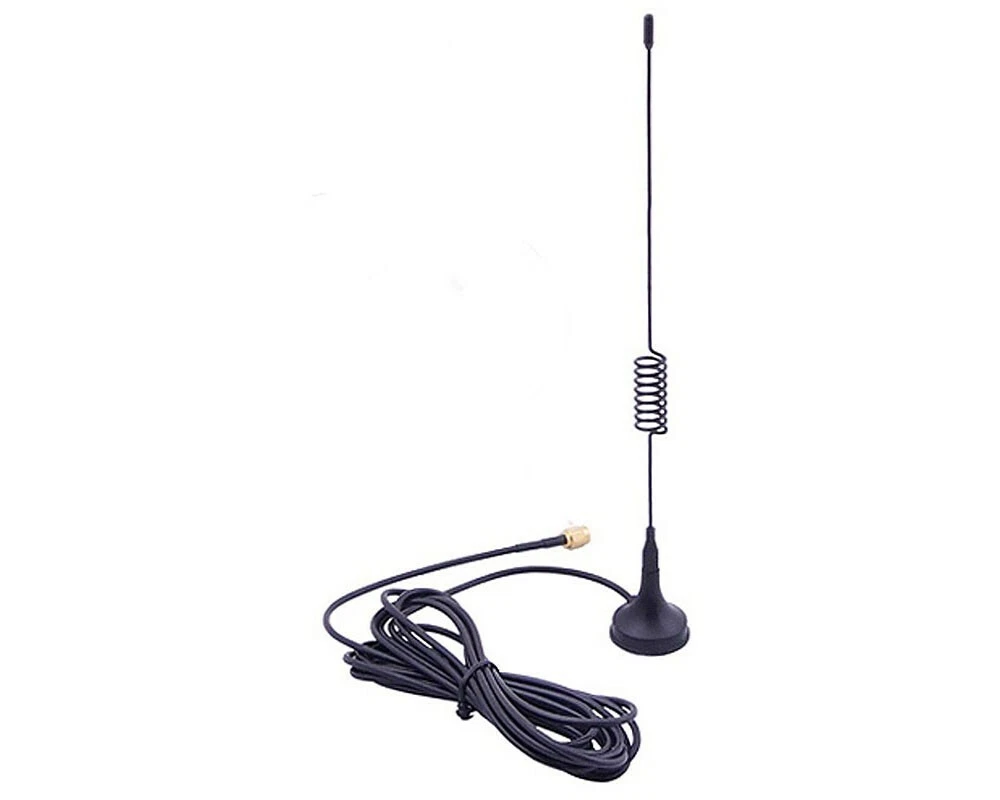
Extended 5-Metre Cable: Provides significantly more installation flexibility than shorter cables, allowing you to position the antenna for optimal reception even if the router is deep inside a building. However, 5 metres is generally considered the maximum practical length for this type of antenna, as signal loss becomes significant beyond this point .
Low-Loss Cable Construction: To combat the inherent signal attenuation over 5 metres, manufacturers use better cable types. While basic kits might use RG58, higher-quality antennas often employ low-loss cable like LMR200 or CFD200 to preserve more signal strength . Some upgraded RG58 variants feature enhanced shielding (e.g., 128 braids instead of 96) to reduce loss .
Omni-Directional Reception: Most 4G antennas of this type are omni-directional, meaning they receive and transmit signals from all directions (360°) simultaneously. This makes installation simple, as you don't need to precisely aim them at a cell tower .
Multi-Band Frequency Support: They are designed to cover the primary global 4G/LTE bands, typically spanning 698-960 MHz, 1710-2170 MHz, and 2500-2700 MHz, ensuring broad compatibility with different network operators .
Weatherproof Outdoor Design: For permanent outdoor mounting, these antennas usually feature an IP67 rating, making them resistant to dust and water immersion. The housings are often UV-stabilised to prevent degradation from sunlight .
SMA Male Connector: The standard connector for this category is an SMA Male, which fits directly onto most 4G routers and modems .